
How to Untangle a Necklace: 6 Guides Compared
How to untangle a necklace gently
Open the necklace's clasp and lay the chain flat in good light. Keep it slack while gently working a fine tool into a visible gap in the knot. Stop if a link bends, a stone catches or the knot tightens, and ask a jeweler to inspect it.
Your necklace has a knot barely bigger than the clasp, and pulling the ends makes it tighter. That tighter knot is a reason to put the necklace down on a flat surface before reaching for oil or powder.
We compared six published untangling guides on October 11, 2026. Every one suggests a pin or needle; five offer oil, and four offer powder. Those are counts of advice, not tests of what works, and we've included the differences below so you can check them.
That starting order is our cautious reading of the guides, rather than a proven method. Oil and powder both need cleanup, which gets awkward when your necklace includes pearls, glued stones or a finish you can't identify; on those pieces, knowing how to remove the residue matters as much as loosening the knot.
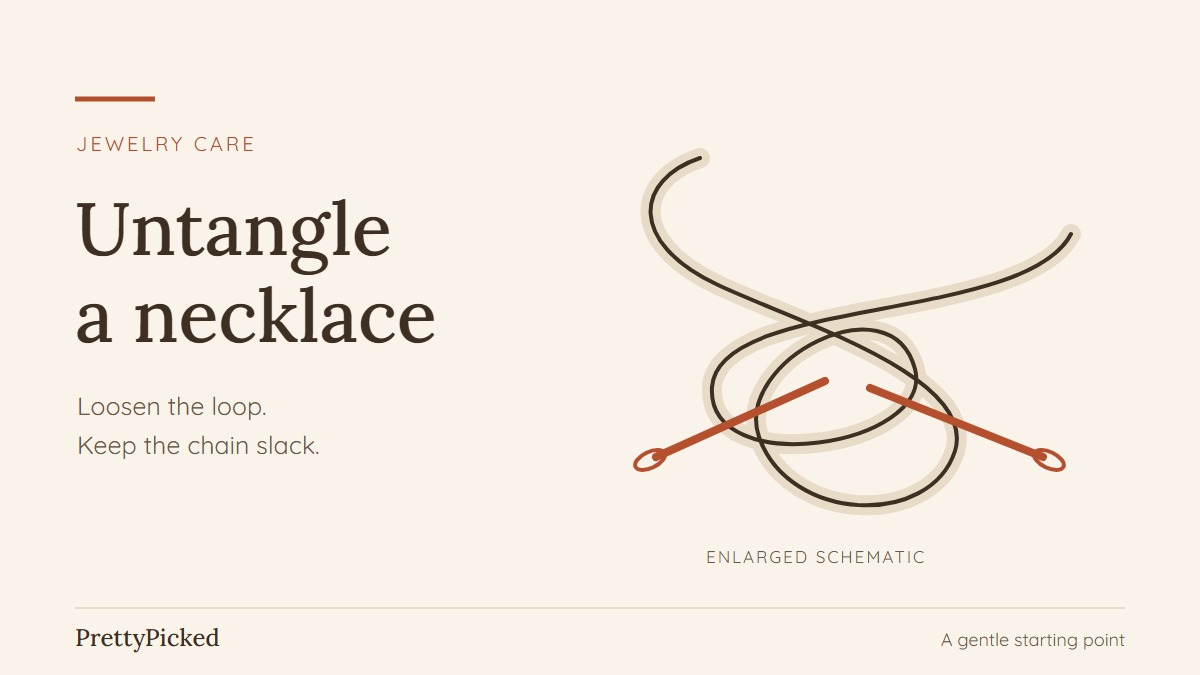
Is your necklace knotted or kinked?
A knot has loops of chain caught through one another. A kink is a bend or fold in the chain itself. Look closely before working on either: a pin can help open a loop, but pushing on a bent link adds force to metal that's already distorted.
TraxNYC distinguishes knots from kinks and sends folded hollow links to its repair bench. Miro Jewelers also advises professional help when a chain or clasp has bent, stretched or broken.
For a loose knot in a plain chain, a careful attempt at home may be reasonable. With a kink, damaged link or unfamiliar construction, ask the maker or a jeweler what the piece needs. A necklace with sentimental value deserves the same restraint as an expensive one.
What do you need to untangle a necklace?
A fine pin, safety pin or sewing needle, a flat surface and good light are the tools the guides return to. Two fine tools can work into a tight knot from different sides. A magnifying glass helps when the individual links are hard to see; skip the sharp tools if you can't control them comfortably.
Perles & Co describes a two-needle method. Miro and TraxNYC also list toothpicks as possible tools.
Use a clean surface where the chain won't disappear into fabric. Keep loose pendants and other necklaces out of the working area. Tweezers appear in several guides, but gripping a tiny link brings another chance to bend it; they aren't essential equipment for a first attempt.
How do you untangle a necklace step by step?
For an ordinary chain knot, work from a slack, open necklace on a flat surface. Loosen the center a little, then guide a free end through the opening that appears. Keep checking the links as you go, and stop if the metal deforms or the knot closes more tightly.
- Open the clasp. Free ends give the chain room to move. Remove a pendant only if it slides off normally; don't force it over a knot or a fixed fitting.
- Spread out the chain. Find the knotted section and lay the surrounding chain down with slack. Holding the necklace up lets its weight pull on the knot while you're trying to loosen it.
- Find a gap you can see. Work the point of a fine tool into that gap with small movements, without scraping, squeezing or levering against a link. Keep fingers clear of the point and avoid stabbing down onto the chain.
- Open the loop gradually. If there's room for a second tool, work from another side. You want space between loops, without stretching the links themselves.
- Guide a free end through. Once the route through the knot is visible, follow it slowly. If the end catches, return to loosening the loop instead of tugging harder.
- Inspect before wearing. Check the worked area and clasp; links that have opened, flattened or changed shape need attention even with the knot gone.
These steps combine the dry-tool instructions from Perles & Co and Miro with TraxNYC's emphasis on slack. They won't cover every chain construction. A very fine necklace, a fixed multi-chain design or a piece with stone settings can justify going straight to a jeweler.
Does baby oil or baby powder untangle necklaces?
Beyond the dry-tool steps, published guides offer oil and powder as ways to help links slide past each other: five of our six pages offer oil, and four offer powder. Those additives aren't universal recommendations; check the chain, its finish, any stones and the cleanup method before adding either.
Sophia Alexander offers a powder method, while The Italian Jewelry Company uses a drop of oil in its sequence. Both follow with cleanup. That extra step is why we'd try gentle dry work first on a piece whose materials we don't know.
| Your necklace | What to check before adding anything |
|---|---|
| Plain solid-metal chain | Read the maker's care instructions, including how to remove any residue afterward. |
| Gold-plated chain | Keep tools gentle and confirm the finish's cleaning limits; dry work avoids adding cleanup before you know those limits. |
| Pearls, opal or turquoise | TraxNYC excludes oil on these materials. Ask for piece-specific advice rather than treating the whole necklace as bare metal. |
| Glued stones or an unknown vintage finish | Miro excludes these from its soaking method. Avoid a bath or household cleaner without guidance for the actual piece. |
| Bent or damaged links | Additives won't repair the metal. Have the chain inspected. |
The table gives reasons to pause, rather than a promise that any additive is safe. GIA notes that pearls scratch easily and need careful cleaning. Pins, residue removal and even storage can require a different approach when a chain carries delicate gems.
If your piece is plated, our gold-plated jewelry cleaning guide covers the care question separately. Untangling and cleaning can be two different tasks.
Can you untangle a necklace with water?
Water alone doesn't show you how to open a chain knot. Miro Jewelers suggests a brief warm, soapy soak for buildup that holds links together, with exclusions for glued stones and unknown finishes. The other pages in our sample mainly mention water for cleaning away oil or powder after untangling.
After untangling, a cleanup rinse removes residue; that instruction doesn't mean the same source recommends soaking the necklace to undo the knot. Cleanup and soaking stayed separate when we counted the methods.
Real Simple also offers a glass-cleaner method. We wouldn't make that a general recommendation: GIA specifically cautions against ammonia-based cleaners on organic and porous gems. A household bottle doesn't tell you whether your necklace's stones, treatments or finish can tolerate it.
For an unidentified piece, stay with a gentle dry attempt or get advice from the maker. You can decide how to clean it once you know what it's made of and whether the links are sound.
What did the six guides recommend?
Here's our dated comparison. "Yes" means the page offers that method; "Not listed" means it wasn't offered in the text we read. It doesn't mean the author tested, approved or rejected the method for your particular necklace.
| Published guide | Pin or needle | Oil | Powder |
|---|---|---|---|
| Sophia Alexander | Yes | Not listed | Yes |
| TraxNYC | Yes | Yes | Not listed |
| Perles & Co | Yes | Yes | Yes |
| Miro Jewelers | Yes | Yes | Yes |
| The Italian Jewelry Company | Yes | Yes | Not listed |
| Real Simple | Yes | Yes | Yes |
Five pages come from jewelry businesses or a jewelry-supply company. Real Simple is a magazine with a named jeweler interview. Advice can be repeated between pages, so six guides don't amount to six independent expert opinions or six repair trials.
We read two GIA care pages as material checks, but they sit outside the table's denominator; four other pages we attempted didn't return usable article text and aren't included. No necklace was tested, and no repair cost or success rate was measured.
How do you untangle two necklaces or multiple strands?
Open the clasps that you can reach and identify which loops belong to each necklace. Work on a loose outer section first, keeping the rest flat. Miro describes following one chain at a time; TraxNYC advises working from outer knots toward the middle when two chains are caught together.
Keep a freed chain away from the remaining tangle so it doesn't become another loose end to track. Even after most of its length is free, don't yank a chain through a tight knot.
A necklace with several strands permanently attached to the same clasp has fewer free ends than separate necklaces. If you can't follow a strand through the knot, let a jeweler examine the construction. Once the chains are free, our necklace-layering guide deals with arranging them for wearing.
Will a jeweler untangle a necklace?
A jeweler can inspect the tangle, check the links and decide whether the necklace needs untangling, repair or both. Miro and TraxNYC invite readers to bring stubborn or damaged pieces in. Ask about the service and its price first; our research doesn't establish a standard fee or a free-service promise.
Celebrity jeweler George Khalife, interviewed by Real Simple, puts the frustration plainly: "Untangling chains can be a big headache."
Stop when the chain changes shape
Bent links, a distorted clasp, a caught stone setting or a knot that keeps tightening are reasons to stop. The same applies when you can't see the individual links or handle a fine tool comfortably. Ask a jeweler to inspect the piece before trying more force.
If you can, take a clear photo of the problem before asking the shop what to do next. Keep every loose piece if anything has broken. Avoid breaking a chain by cutting it or trying to straighten it with pliers while you're waiting for advice.
More necklace-knot questions
Can I untangle a necklace while I am wearing it?
How long does untangling a necklace take?
Can I use lotion or a household cleaner instead of oil?
How do you store necklaces to avoid tangles?
Store chains separately and fasten the clasps before putting them away. Miro recommends individual compartments or pouches; Sophia Alexander also describes bags and straw storage. The aim is to give each chain its own space so loose ends aren't threaded through neighboring necklaces.
For sterling silver, storage also affects tarnish. Our sterling-silver tarnish guide compares that care advice, while the jewelry buying guide gives context for checking a maker's materials and instructions before buying another chain.
Packing a necklace as a gift? Secure it separately inside the jewelry box before following our present-wrapping steps. After the knot is out and the links are checked, close the clasp and give the chain its own compartment.
psst, want the good ones first?
Our best Etsy finds, in your inbox.
At most one email a week, only shops we'd buy from ourselves. Unsubscribe with one click.
We send one confirm link first. Read how we handle your email in our privacy policy.
More Picks You Might Like
Does Sterling Silver Tarnish? Yes. 11 Care Guides Compared
Yes, sterling silver tarnishes. We compared 11 jeweler care guides: what they all agree on, and the six fixes they argue about, from baking soda to soap.
JewelryHow to Clean Gold Plated Jewelry Without Stripping It
How to clean gold plated jewelry: use dish soap and a soft cloth, skip what strips plating, and check what 32 Etsy sellers say about care. Only 4 mention water.
GiftsHow to Wrap a Present and Tie a Bow: Paper and Ribbon Sizes
Wrap a present and tie a bow step by step, with paper and ribbon sizes for 5 box shapes plus what 473 Reddit comments say goes wrong and how to fix it.
GiftsPersonalized Gifts on Etsy: 10 Picks From $4 I'd Send
Skip the generic mug. I vetted dozens of personalized gifts on Etsy and kept 10 winners from $4, sorted by recipient, each with a 4.7-plus-star rating.